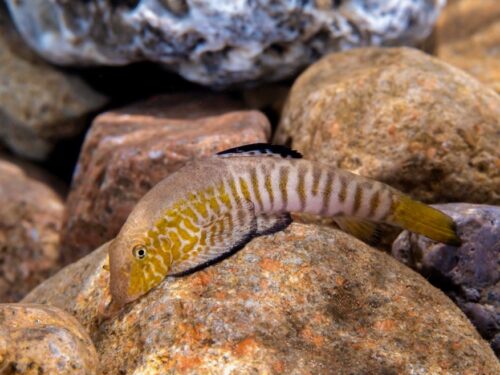


Snijders’ Pink-Finned Harlequin Halfbeak
$49.99
Snijders’ Pink-Finned Harlequin Halfbeak
Nomorhamphus liemi snijdersi “Pink Fin”
Common Name: Snijders’ Halfbeak, Harlequin Halfbeak, Northern Harlequin Halfbeak, Pink-Finned Halfbeak, or Flamingo Fish
Latin Name: Nomorhamphus liemi snijdersi (Vogt, 1978)
“Moniker” or “Location:” “Pink Fin”/“Maros”
Native Range: Maros, Sulawesi
Broodstock Heritage: Sulawesi (Wild); Imported by Moonlight Aquatics (WA, USA)
Adult Size: 2.50” (Males); 4.50” (Females)
Lifespan: 8+ Years
Breeding Strategy: Livebearer (read below)
Temperament: Peaceful
Care Level: Easy/Beginner
Out of stock
Description
A year after describing true black-finned Nomorhamphus liemi liemi, Vogt returned to Sulawesi on another expedition, again to the Maros region. This time he would discover a magenta phenotype of N. liemi, restricted to Northern Maros, naming these pink fish N. liemi snijdersi. There has been historical debate among aquarists, importers, and taxonomists about the validity of the subspecies of N. liemi and snijdersi, with some sources refuting their phenotypic differences. Finding photographic evidence for comparisons of the two subspecies is nearly impossible… Luckily for the world, Hillstream Kingdom LLC can end the debate here, now and forever: there are indeed two (2) distinct, unique subspecies of Nomorhamphus liemi––and we have both in our possession (black-finned N. liemi liemi, and pink-finned Nomorhamphus liemi snijdersi). Our wild breeding groups were purchased from different suppliers; our black-finned Nomorhamphus liemi liemi were imported by Wes Wong of Rare Fish (Irvine, CA), and our pink-finned N. liemi snijdersi arrived amazingly healthy from Moonlight Aquatics (WA, USA).
Pet Husbandry
The Atherinomorpha Infraseries, the “Gemscale Family” as we call them, is a large grouping of attractive fish containing three (3) lineages considered “True Gemscales.” The first lineage of True Gemscales: I. Atheriniformes from Sahul––the well-known Blue-Eyes, Hardyheads, Rainbowfish, Silversides, and so much more. The second lineage of True Gemscales is II. Beloniformes from Sundaland (Southeast Asia), and contains live-bearing Halfbeaks––freshwater versions of their flying fish siblings; egg-scattering wild Oryzias species (sp.); and the ever-popular Japanese Medaka cultivars (var.). The final lineage of True Gemscales is III. Procatopodidae, Lampeyes from Africa. Relatively unknown in the US hobby and trade, Lampeyes are like a hybrid Blue-Eye and Ricefish offspring, with colors and patterns like tropical reef fish. Lampeyes were once considered part of the Killifish Family (Cyprinodontiformes; specifically as the sister lineage to Poeciliidae “South American Livebearers”). However, recent genetic evidence suggests Lampeyes are a distinct, novel lineage within the Gemscale Infraseries.
Most Gemscales (fish from the Atherinomorpha Infraseries Family) are happiest in an ambient, room-temperature aquarium (68F-80F) with adequate filtration and aeration. Gemscales are usually proper river fish or come from true hillstreams and jungle brooks. Gemscales are fast-moving and take time to reach maturity. Larger, older fish will need more space to swim; with good care, many Gemscales continue growing and reach very old ages for aquarium fish.
“Good husbandry” would consist of bi-monthly water changes of 20%-40%, helping to prevent poor aquarium conditions from manifesting. Offering the fish a mature, well-planted aquarium will encourage breeding behavior and help the tiny mermaids (Gemscales’ Chinese name) feel safe and secure. The Mandarin Chinese name for Gemscales translates as “mermaid with the [fill in fin color] colored hair,” with “hair” meaning their fins; no distinction is made between Rainbowfish, Ricefish, or Lampeyes by the Chinese––they are all “mermaids” in their eyes… The Chinese are a symbolic culture and name animals as such. What’s special about the Gemscale (Mermaid?) Family (Atherinomorpha Infraseries) is their social behavior, beauty, and “wet pet” personalities.
Each lineage of Gemscales has their own “husbandry quirks.” For instance, we’ve found most Procatopodidae Lampeyes quickly perish in the presence of any aquarium products containing essential oils (avoid Clove Oil, Melafix, Pimafix, etc.; all these products quickly kill Lampeyes). Lampeyes (Procatopodidae) also tend to be weak against Columnaris-type pathogens from Asia and the America. Rainbowfish and Blue-Eyes (Atheriniformes), and Halfbeaks and Ricefish (Beloniformes), tend to be weak against pathogens from Africa and the Americas. Little Gemscales like Hylopanchax spp., Oryzias spp., and Pseudomugil spp. do not like any “ammonia binder” products in their aquarium or shipping water (Kordon AmQuel Plus, etc.), often perishing some days after exposure to the chemicals. Typical lifespan is 3-5 years old for smaller Genera like Oryzias spp., Poropanchax spp., and Pseudomugil spp.; larger-growing Genera like Glossolepis spp., Lamprichthys spp., or Melanotaenia spp. can easily reach their “teens” and onwards, achieving titanic sizes in older age. Some “old timer” hobbyists and public aquariums have 25+ year-old Melanotaenia boesemani…
Feeding
All Gemscales (fish from Atherinomorpha Infraseries Family) are gluttons for food and will beg to be fed like cats and dogs––sparkly, little bodies tracing your every movement across the front aquarium glass… If your Gemscales are not excited to eat or see you, something is wrong! Daily feedings of quality live, prepared, frozen, or dried foods are encouraged. Live Artemia nauplii (“live baby brine shrimp”) is their favorite food in the world.
Female Halfbeaks (Dermogenys spp., Hemirhamphodon spp., and Nomorhamphus spp.), of the Beloniformes, will require insect protein in their daily feedings––needed to support the litter of growing embryos within their wombs. Fluval Bug Bites (granules) are extremely popular with female Halfbeaks and are also enjoyed by non-livebearing Gemscales––and their Hillstream Loach companions practically inhale the sinking extras or wayward scraps.
Tankmates
Being communal fish, a minimum school-size of six (6) individuals is suggested. When it comes to co-housing Gemscales with other fish, the best roommates are other Gemscales from the Atherinomorpha Infraseries Family. And Hillstream Loaches from the countless Gastromyzontidae lineages.
Behaviorally, the three groups Gemscales (Atheriniformes, “Aformes;” Beloniformes, “Bformes;” and Procatopodinae, “Pformes”) all share active, communal, social, and peaceful demeanors. The three lineages also prefer to communicate in a seemingly-identical fashion: amplifying their colors, flashing patterns, and spreading their fins whist engaging in dominance displays.
Cleanup crew for Gemscales? Hillstream Loaches from the Gastromyzontidae lineages are the only choice. Making for excellent long-term roommates in Gemscale aquariums, the undine-like loaches come from clear-water streams across mainland Southeast Asia and Borneo (Sundaland), inhabiting identical environments as the Gemscales; even co-occurring with them in some cases. The Hillstream Loaches have tiny, downwards-facing mouths with very little bite-power, making them egg and fry-safe. Tandem-breeding Gemscales and Hillstream Loaches is becoming commonplace in the American Rainbowfish and Hillstream Loach hobbies.
Hillstream Loaches are also able to graze unwanted algae off any surface and help keep their aquariums extremely clean, without disturbing the breeding Gemscales. Lastly, the Gastromyzontidae Hillstream Loaches also use near-identical behavioral cues to the Gemscales: communicating through fin flashing, color and pattern amplification, and making chirping like sounds by jaw clicking and rasping bands of muscles on their swim bladders. Crazily enough, Gemscales and Hillstream Loaches have often been known to interact in the home aquarium… Should sparring Gemscales swim near a perching Hillstream Loach: expect fin flaring, chasing, or perhaps a tail swat from the little undine.
Breeding
Creating a large, home-bred school of Gemscales is very achievable with good, consistent husbandry, a rearing strategy, and the correct setup. Three (3) breeding strategies are used by the Gemscale Family (Atherinomorpha Infraseries), depending on the lineage of fish. The first is I. “Egg-Scattering,” whereby fertilized eggs are deposited into aquatic vegetation or spawning mops after mating rituals… typical aquarium fish breeding behavior.
The second strategy is II. “Crevice-Spawning.” In this method of reproduction, fertilized eggs are deposited into rock cracks and gaps in surrounding hardscape, rather than aquatic vegetation after mating rituals. Often, porous filter media in the home aquarium is selected as a breeding site for crevice-spawners. Gemscales inhabiting waterbodies without ample aquatic vegetation will often use this strategy. Some examples of crevice-spawning Gemscales would be the northern populations of Pseudomugil signatus in Australia; many of the river Procatopus spp. from deep in the nearly pitch-dark Congo Rainforest; and most famously, Lamprichthys tanganicanus of Africa’s Lake Tanganyika, known for depositing massive, multi-colored eggs into the lake’s granite-shelved shoreline. For “Crevice Spawners,” a breeding mop can be wrapped in large-pore screen from the hardware store, then zip-tied together; a “screen mop” to suit the crevice-spawners’ breeding needs! Sponge filters with large pores like Aquarium Co-Op and Swiss Tropicals brands seem to be favored laying sites with crevice-spawning Gemscales.
Nearly all fry hatched from the first two strategies (I. Egg-Scattering & II. Crevice-Spawning) emerge the same size. Some Gemscales, like Japanese Medaka (Oryzias latipes var.) and Honey Blue-Eyes (Pseudomugil mellis), require longer, quality photoperiods (daylight duration) to produce eggs, and for the fertilized eggs to properly develop. A strong LED grow-bulb for plants easily fulfills this need and can be purchased from any hardware store. Generally, to get Medaka and Honey Blue-Eye-type Gemscales to produce indoors, offer 12-16 hours of quality photoperiod per 24-hour cycle. All aquarium fish tend to have more robust health, display better behavior, and show better colors with quality photoperiods. Most Gemscale fry can accept Artemia nauplii after hatching. Provide smaller Gemscale fry, like Melanotaenia spp., powdered food like Golden Pearls until they’re able to accept “live baby brine shrimp” (A. nauplii). All Gemscales will continue eating A. nauplii “baby brine” their entire lives, adult Halfbeaks and Rainbowfish included!
The final breeding strategy is III. “Live-Bearing.” The only live-bearing Gemscales are Halfbeaks (Dermogenys spp., Hemirhamphodon spp., and Nomorhamphus spp.): every four (4) to six (6) weeks, female Halfbeaks will become quite round, seemingly ready to burst. Within the females’ bellies are several (4-12+) quarter-inch long baby halfbeaks––“beaklets.” Larger females will give birth to more beaklets. Beaklets emerge ready to eat and are rather feisty. Do not house freshly-born beaklets with freshly-hatched Gemscale fry: the beaklets will practically inhale their baby cousins; a single beaklet can wipe out an entire aquarium of Strategy I & II fry overnight! Do not put newborn baby beaklets with adult Halfbeaks or large Gemscale; they will be ripped to shreds. Newborn beaklets can be reared with adult Blue-Eyes, Ricefish, or other similar-sized Gemscales (Pygmy Lampeyes, etc.). Baby Gemscales, no matter the lineage, are the cutest baby fish you’ll ever see!